

TL;DR
Tokyo Techies engineer Thanh presented at the 2026 International Conference on Advances in Artificial Intelligence and Machine Learning (AAIML 2026) in Tokyo. He showcased a platform built for Japan's National Institute of Information and Communications Technology (NICT). This platform removes the need for engineering support every time a researcher runs an experiment, giving scientists full control over their own work, from setup to results.
Event at a Glance
Event: AAIML 2026, Tokyo | Venue: Chuo University, Korakuen | Session: AI Model Co-creation Hackathon | Client: NICT, Japan
What problem were we solving?
AI researchers are experts in science - not server configuration. Before Tokyo Techies stepped in, every new experiment at NICT required an engineer to set up servers, write scripts, and set up infrastructures.
We call this infrastructure friction. It’s the invisible wall that keeps scientists from doing their research, costing them hours and momentum.
What did Tokyo Techies build for NICT?
We built a Graphical User Interface (GUI) on top of NICT's federated edge AI simulation platform, making the heavy lifting invisible while providing researchers a way to work freely.
- Configure experiments visually. No scripts, no command line. Researchers now design experiments through a clean, intuitive interface.
- Launch simulations with one click. No waiting for support. If a researcher has an idea, they can now run their experiments immediately.
- Monitor results in real time. Scientists can watch their simulations live, allowing them to adjust and learn faster than before.
The complexity is still there under the hood. We just made it invisible.
What is Federated Learning, and why does it matter?
Think of it as “bringing the brain to the data.” Federated learning is an AI training method where the model travels to the data, not the other way around.
Devices train locally and share only model updates, never raw data. This keeps sensitive information private, making it essential for healthcare, finance, and government organizations where data cannot easily leave the organization.
Simulating federated systems is technically complex, which is why our GUI made a real difference for the NICT team.
What was it like presenting at AAIML 2026 for Thanh?
The conference was held at Chuo University's Korakuen Campus. Outside, the Tokyo Dome area buzzed with high-energy crowds; Inside, the atmosphere was academic contrast where researchers across Asia to Europe gathered to discuss the future of AI.
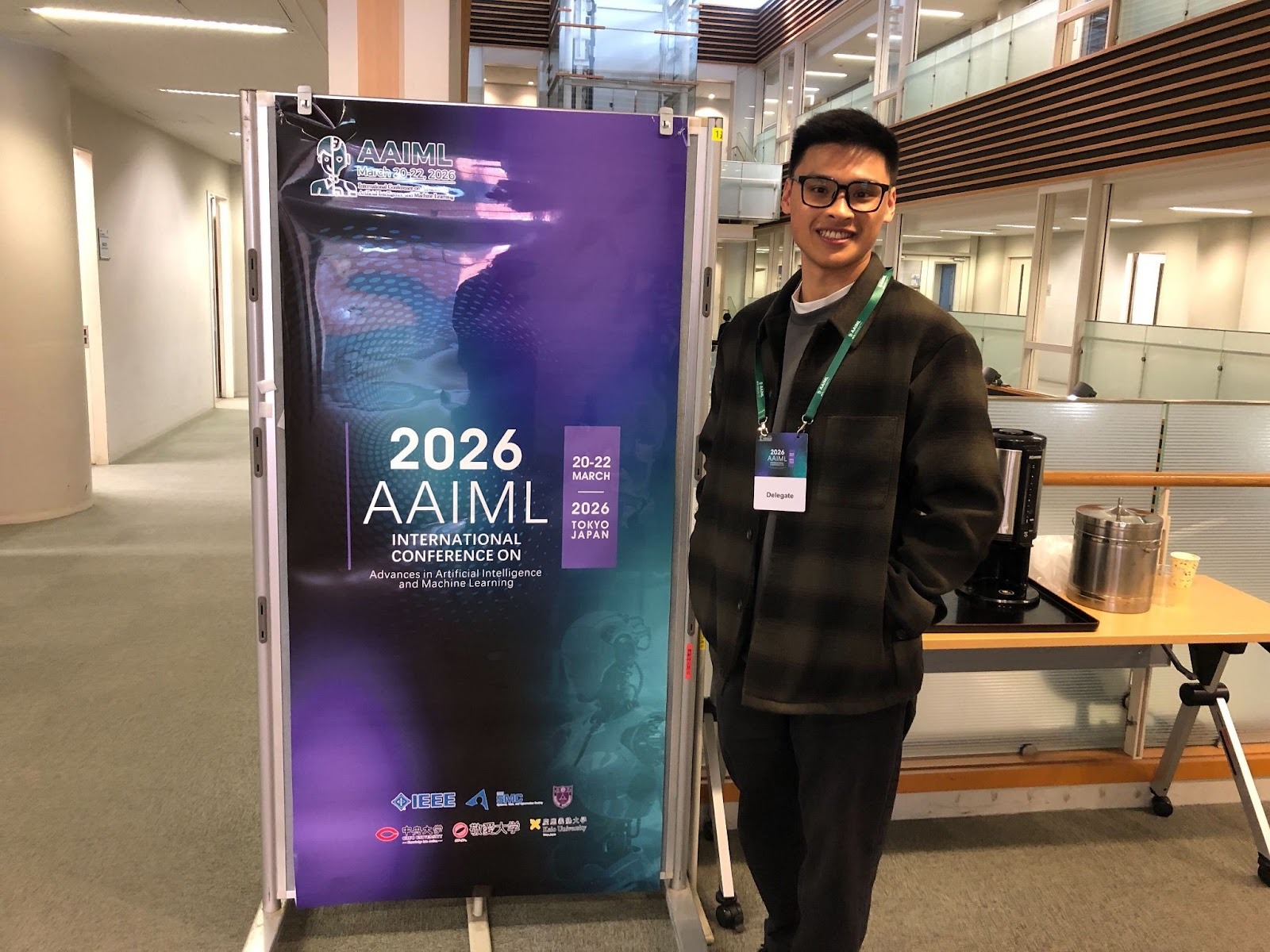
For Thanh, it was a first: presenting at an international offline conference.
"I stopped thinking about my own performance and focused on the value we were sharing. Once I did that, the nerves disappeared. I wasn't giving a speech, I was sharing a solution." - Thanh
He also met his NICT collaborators in person for the first time after a year of online-only calls.
"They were just 'mysterious voices' on a call to me. Meeting them in person at the conference for the first time was a highlight. It changed the dynamic instantly. It finally felt like I was working with actual human beings, which made the partnership feel much more real and rewarding." - Thanh
What is the real impact of this work?
We don't change what researchers discover. We change how freely they can pursue discovery.

As Thanh put it: "I realized that our project is a vital link in the chain. We don’t change the research results directly, but we change the lives of the people doing the research. By automating the server setups and scripts that used to require an engineer's help, we’ve empowered researchers to focus 100% on their science. We are the bridge that turns a complex experiment into a simple click."
Bottom Line
Most experiments started the same way: a researcher with an idea, and an engineer they had to wait on before anything could happen. Tokyo Techies changed that by building a Graphical User Interface that handles the hard technical work quietly in the background, so researchers can focus on research, not the setup.
At Tokyo Techies, this is what we do best: make complex systems easy for anyone to use. If your team is stuck in the same cycle, we would love to help move things forward.
Contact us.

.png)
