

TL;DR
- Japan's government warned in 2018 that old IT systems could cost the economy up to 12 trillion yen a year from 2025. That year has passed. The costs are real.
- Around 60% of IT systems in Japan are over 20 years old. Some date back to the 1980s.
- Nearly 77% of Japanese companies say they are working on digital change. Only one in three has real results to show.
- Old systems consume up to 80% of IT budgets, leaving almost nothing for new tools or security.
- A device connected to the internet in Japan faces a malicious attempt every 13 seconds.
- Companies moving now are pulling ahead. Those waiting are falling further behind.
Japan's Unexpected IT Problem
Japan is known for getting things right. Bullet trains run on time. Factories set global standards. The electronics industry shaped modern life.
So it surprises many people to learn that Japan is quietly dealing with one of the biggest technology problems in the developed world. Many businesses still depend on old IT systems that are expensive to maintain, impossible to properly secure, and unable to support the tools companies need today.
This is not a new observation. Experts have been raising the alarm for years. But in 2026, the warnings have turned into real consequences. The cost of waiting is becoming harder to ignore.
1. How Big Is the Problem?
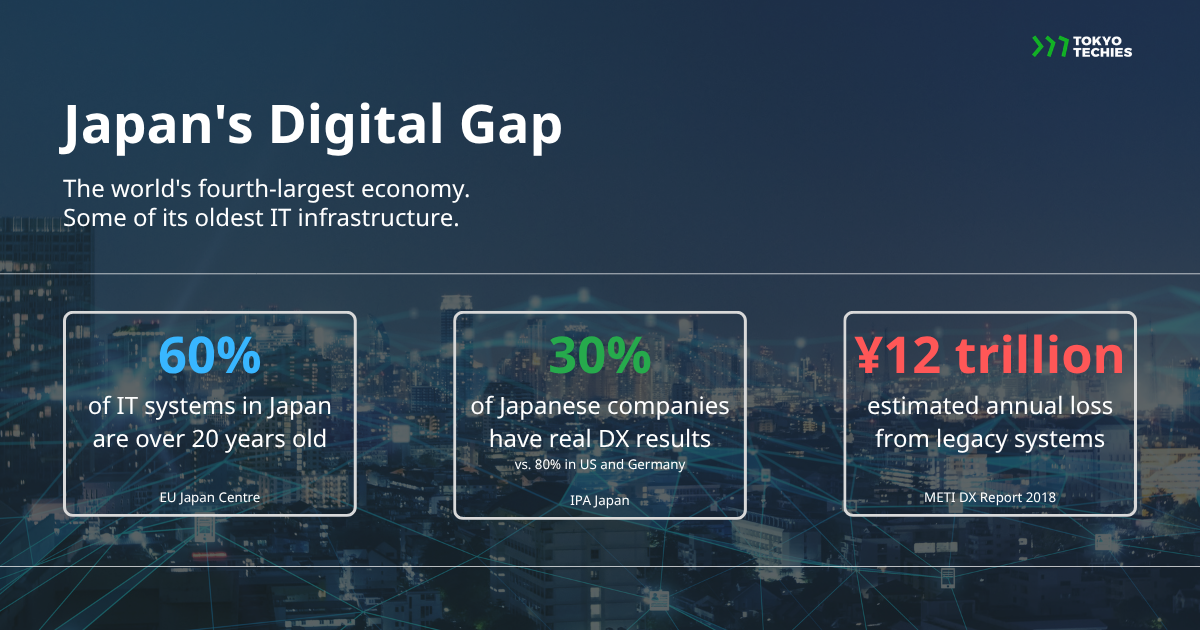
In 2018, Japan's Ministry of Economy, Trade and Industry (METI) warned that failing to modernise IT systems could cost the country up to 12 trillion yen, roughly 80 billion US dollars, every single year from 2025. They called it the "2025 Digital Cliff."
That year has passed. The damage is slow and steady, but very real.
The numbers:
- Over 60% of IT systems in Japan are now more than 20 years old (EU-Japan Centre/ ULPA)
- Only 30% of Japanese companies have made real progress on digital transformation, compared to 80% in the US and Germany (IPA Japan)
Forrester Research noted in December 2025 that the problem is not awareness. It is strategy. Most companies have been digitising their existing processes rather than rethinking how they work.
2. What Old Systems Are Actually Costing Your Business
Running on old systems is not just a maintenance problem. It creates a much bigger set of hidden costs that grow every year.
The IT Budget Trap
Old systems can swallow up to 70 to 80 percent of IT budgets just to keep running. For every 100 yen spent on IT, as much as 80 yen goes toward maintaining what already exists, not building anything new.
Better security, cloud tools, AI features, new customer capabilities - all of it has to come from whatever is left. That is why so many IT teams feel stretched, not from lack of effort, but because almost every resource goes toward keeping old systems alive.
Productivity That Quietly Disappears
Old systems create daily friction:
- They are slow and often cannot be accessed remotely
- They require manual steps that modern systems would handle automatically
- Staff maintain separate spreadsheets and re-enter data by hand
Research by Stripe found that developers dealing with legacy systems lose an average of 13.5 hours every week to problems those systems create. That is nearly a third of their working time and it rarely shows up clearly on any report.
A Security Risk That Keeps Growing
Every 13 seconds, a device connected to the internet in Japan faces a malicious attempt (CYDEF 2025).
Old systems cannot support modern security standards. Many run on software that no longer receives updates and cannot be properly patched. Attackers know exactly where the gaps are.
In recent years:
- Asahi Group Holdings was hit by ransomware and spent months recovering
- Japan Airlines faced a cyberattack in December 2024 that delayed dozens of flights
- A major internet cafe chain had 7.29 million customer records exposed
In each case, outdated technology made the damage worse than it needed to be.
3. Why Has This Problem Lasted So Long?
If the risks are clear, why are so many companies still running on old systems? The honest answer is that it is more of a people problem than a technology one.
- "It still works" - changing a functioning system feels like unnecessary risk
- Nobody fully understands it - many systems were built decades ago by people who have since retired
- The budget is already gone - when 80% goes to maintenance, there is little left for change
- Not enough people - Japan faces a shortfall of up to 450,000 IT professionals by 2030
These are real constraints, not excuses. The companies making progress are working around them by starting small and building from there.
4. What Modernisation Actually Looks Like
Most companies assume fixing old systems means replacing everything at once. It rarely does.
The best approach is simpler. Start with the problem causing the most pain. Fix that properly. Then move to the next one. Here is what that looks like in practice:
- Start with a clear problem, not a technology. Ask where you are losing the most time or money right now. That answer shapes everything.
- Free your data. In many Japanese companies, critical information is trapped inside old systems with no easy way to access it. Getting data into a modern, usable format is often the most valuable first step.
- Fix security early. Any modernisation effort should include a security review. It is far easier to build protection in from the start than to add it later.
- Set a baseline and measure progress. Know what a process costs or how long it takes today, so you can clearly show what improved and by how much.
The goal is not a perfect system. It is a better one that your team can use and keep improving over time.
5. How Tokyo Techies Is Helping Companies Move Forward
We work with companies in Japan and the US that are dealing with exactly this. Old infrastructure becoming a security risk. Data locked inside outdated systems. IT budgets are spent mostly on keeping things running rather than building something better.
Our approach is simple. Find the problem causing the most pain, fix it properly, and build from there.
A real example: Meetruck Corp
Meetruck Corp, a joint venture between SoftBank Group and Nippon Express Group, was still running logistics operations on spreadsheets, printed forms, and fax machines.
We built them a full Transportation Management System in five months. Dispatchers, drivers, accountants, and administrators all moved onto one shared platform. The manual process was replaced with a single digital system now used by logistics companies across Japan.
Read the full story at tokyotechies.com/success-stories/meetruck
The Cliff Has Been Reached. What Matters Now Is the Next Step.
The 2025 Digital Cliff was not one dramatic moment. It has been a slow build of rising maintenance costs, lost productivity, and growing security risks.
The good news is that this is solvable. Companies across Japan are making real progress by starting with one clear problem and solving it well. The ones that start now will be in a much stronger position for the decade ahead.
Curious about where your company stands?
We are happy to talk through your IT setup honestly. No jargon, no pressure.
Reach us at tokyotechies.com

.png)
