Summary
Client: A SaaS platform ecosystem for Transport & Logistics enterprises in Japan
Services Provided: Full-cycle development (Multi-tier Web Admin & Mobile App for drivers)
Key Technologies: Geofencing, GPS Tracking, AI Image Processing, Offline-first Database
The Case
Introduction: The Continuous Regulatory Squeeze from the "2024 Problem" to the "2026 Amended Law"
In April 2024, Japan's logistics industry was hit by a seismic regulatory shift known as the "2024 Problem." To combat historically harsh labor conditions, the government strictly capped truck drivers' overtime at 960 hours per year. While beneficial for drivers' well-being, this created an immediate crisis for transport companies: a massive drop in transportation capacity and the looming threat of severe legal penalties for non-compliance.
However, the regulatory wave did not stop there. Starting in fiscal year 2026, the "Amended Logistics Efficiency Act" comes into full effect. This law targets the industry's multi-tiered subcontracting structure, placing massive administrative burdens and legal responsibilities on shippers and primary contractors. Under these new 2026 mandates, companies are legally required to digitize and document all transport rates and agreements, while also maintaining a highly rigorous "Actual Transportation System Management Register" (実運送体制管理簿) to track every subcontractor physically hauling cargo.
Faced with this evolving landscape, our client realized that their next-generation Transport Management System (TMS) couldn't just be a standard tracking utility. It had to be a robust, future-proof compliance audit engine - one designed to eliminate operational inefficiencies down to the minute while surviving strict government audits under both the 2024 and 2026 legal frameworks.
Building a system capable of meeting these extreme compliance standards posed extraordinary business and technical hurdles.
First, the system had to support a highly complex "B2B2B" multi-tier business model. Secure, hierarchical data flow and granular permission control were required to seamlessly link sales agents, primary transport companies, subcontractors, and thousands of active drivers on the road.
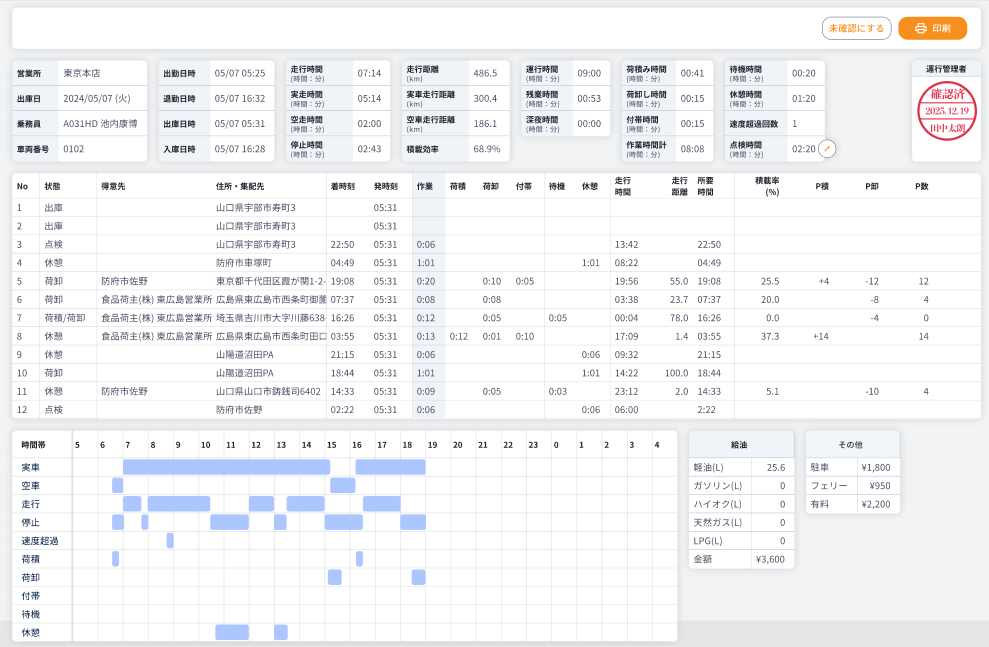
Second, under this double-layered regulatory framework, documents like Driver Daily Reports (運転日報) and subcontractor registers serve as legally binding proof of compliance. Driving hours, distances, rest periods, and contractual relationships must be recorded with zero tolerance for error. Consequently, the user interface had to look pristine on web screens and translate into pixel-perfect physical printouts (Print-friendly) for audits.
Third, we had to defeat the ultimate technical enemy of tracking apps: GPS Drift (位置飛び). Mobile GPS signals are inherently noisy. Even when a truck is stationary, coordinates constantly bounce. This drift accumulates as "ghost miles," inflating recorded driving distances, skewing labor calculations, and inadvertently exposing transport companies to compliance violations during audits.
Our Solution: Tech Meeting Deep Domain Expertise
To resolve these high-stakes challenges, our team at Tokyo Techies engineered a highly resilient, modern system architecture that automates compliance reporting and dramatically reduces driver workloads.
Driver-Centric Mobile App: Geofencing Automation
With strict overtime limits, every minute of a driver's shift represents a finite resource. Our core development philosophy was to design a workflow where drivers could focus entirely on safe driving rather than manual data entry.
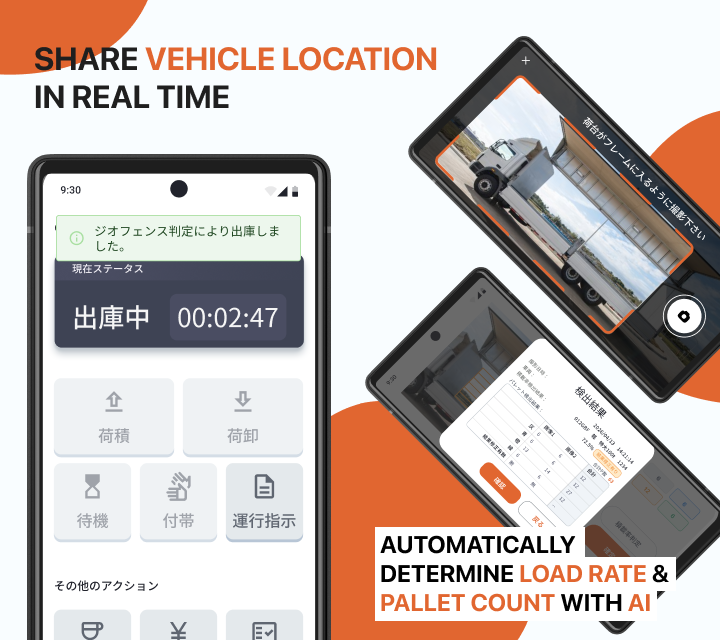
To achieve this, we developed an intelligent geofencing system that automatically detects when a truck enters or exits a warehouse, hub, or depot. The system automatically triggers "Check-in" and "Check-out" actions via GPS coordinates, completely eliminating manual time-logging. This not only lightens the driver's administrative load but also secures highly accurate, tamper-proof timestamps for future regulatory audits.
Defeating Signal Noise: Custom GPS Anti-Drift Algorithm
GPS signal noise was a critical threat to compliance data integrity. For instance, when a truck parked for a driver's legally mandated rest break, coordinate drift would make the app believe the vehicle was still moving, falsely logging rest hours as active work.
To solve this, Tokyo Techies bypassed sole reliance on raw GPS telemetry. We developed a proprietary GPS anti-drift algorithm that fuses location data with the smartphone's built-in accelerometer and OS-level Physical Activity State APIs. When the algorithm detects that the device is physically stationary, it immediately locks coordinate updates and completely halts mileage accumulation. This ensured that the data driving the compliance reports remained completely clean and audit-ready.
Squeezing Loading-Dock Delays: Edge AI Integration
To optimize cargo-hold management and save precious minutes during loading cycles, we integrated an edge-based AI image recognition (OCR and object detection) model directly into the mobile application workflow.
Instead of filling out physical clipboards or manually typing quantities, the driver simply takes a photo of the truck bed. The mobile app's AI instantly calculates the "Load Capacity Ratio" (積載率) and counts the physical pallets on the spot. This automated data is immediately pushed to the dispatcher web portal, bringing unparalleled transparency to loading times and drastically accelerating departure times.
Respecting the Paper Culture: 2-in-1 Smart UI/UX
To respect the deep-rooted physical auditing culture in Japan, as well as the new documentation mandates introduced by the 2026 Amended Law, we placed meticulous focus on the output formatting of critical records.
Using advanced CSS media queries, we created a unified UI codebase that delivers a dual-purpose layout. On computer screens, dispatchers interact with a responsive, high-visibility web interface. However, when the print function is triggered, the stylesheet instantly formats the page - removing digital navigation elements, adjusting contrast, and scaling tables perfectly to standard A4 or A3 margins. This ensures that managers can instantly export clean, professional, and audit-compliant Daily Reports, Actual Transportation Registers, and digitized rate agreements with a single click.
Robust Multi-Tenant Security Design
The entire B2B2B supply chain is protected by a highly secure, multi-tenant database schema. Sales Agent Portals allow distributors to securely provision accounts, manage plans, and handle billing details for dozens of individual transport companies.
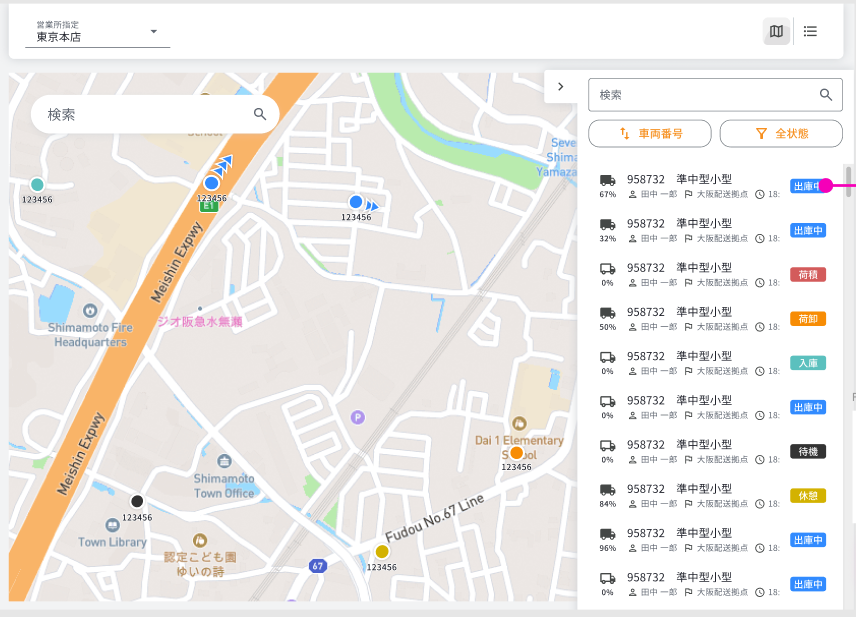
Simultaneously, individual Transport Company Portals provide fleet managers with direct access to driver logs, real-time vehicle routes, and compliance metrics. Under the hood, the data model is built to automatically map subcontractor associations, automatically linking trip logs to the "Actual Transportation System Management Register" required for 2026 compliance.
Beyond Standard QA: The "Hit the Road" Field Testing
This was a unique differentiator for this project. Because non-compliance with the 2024 regulations carries heavy fines, this system demanded physical truth rather than simulated laboratory success.
Unlike standard software development where QA testers run test cases solely behind a desk, our engineers and QA team literally hit the streets. We drove test vehicles across various real-world scenarios - including highways, long tunnels, and deep concrete warehouses with network dead zones - to validate Geofencing triggers, offline data syncing, and the GPS anti-drift algorithm. This rigorous field testing guaranteed that the system wasn't just logically correct on a computer screen, but physically flawless in the real world.
The Results
The Impact: A Resilient Foundation for the Future of Logistics
The system has successfully launched and is actively operating in the field. It is serving as a critical strategic asset for our client and their end-user fleets as they navigate the immediate pressures of the 2024 limits and prepare for the 2026 legal shift.
- Audit Confidence: With GPS drift eliminated and geofences automated, transport companies now possess high-integrity operational data, giving them complete peace of mind when proving compliance with the 960-hour annual overtime limit.
- Streamlined Field Operations: Thanks to the robust offline-first synchronization, drivers no longer face data loss or app crashes in underground depots. The complete automation of time-logging has eliminated manual correction errors, making the app highly popular among drivers.
- Rapid Business Scalability: By delivering a platform that addresses both the 2024 Problem and the upcoming 2026 Amended Law, the client’s sales agents have gained an immense competitive advantage (USP), allowing them to seamlessly onboard new logistics companies looking for advanced compliance solutions.
Looking for a Logistics DX & TMS Development Partner?
Surviving the consecutive regulatory shifts of 2024 and 2026 requires more than a development agency that simply codes to static specifications. You need a technology partner that understands complex regulatory environments and knows how to overcome real-world physical constraints, from GPS drift to poor network coverage.
At Tokyo Techies, we specialize in high-stakes custom software engineering, bringing deep expertise in GPS tracking algorithms, offline-first architectures, mobile AI integration, and localized administrative print engines.
Contact Tokyo Techies today to discuss your business challenges, and let our consultants design the optimal technical path for your digital transformation.