
TL;DR
- The Reality Check: 88% of organizations use AI, but only 6% capture significant financial returns.
- The Key Factor: Workflow redesign - not model selection - is the single strongest predictor of AI success.
- The Opportunity: Most enterprise AI initiatives remain stuck in limited testing, creating a clear advantage for organizations that adopt a structured approach.
- The Solution: Three practical habits - defining early, mapping workflows, and reusing existing tools - turn stuck pilots into long-term value.
Why do most enterprise AI projects fail to scale?
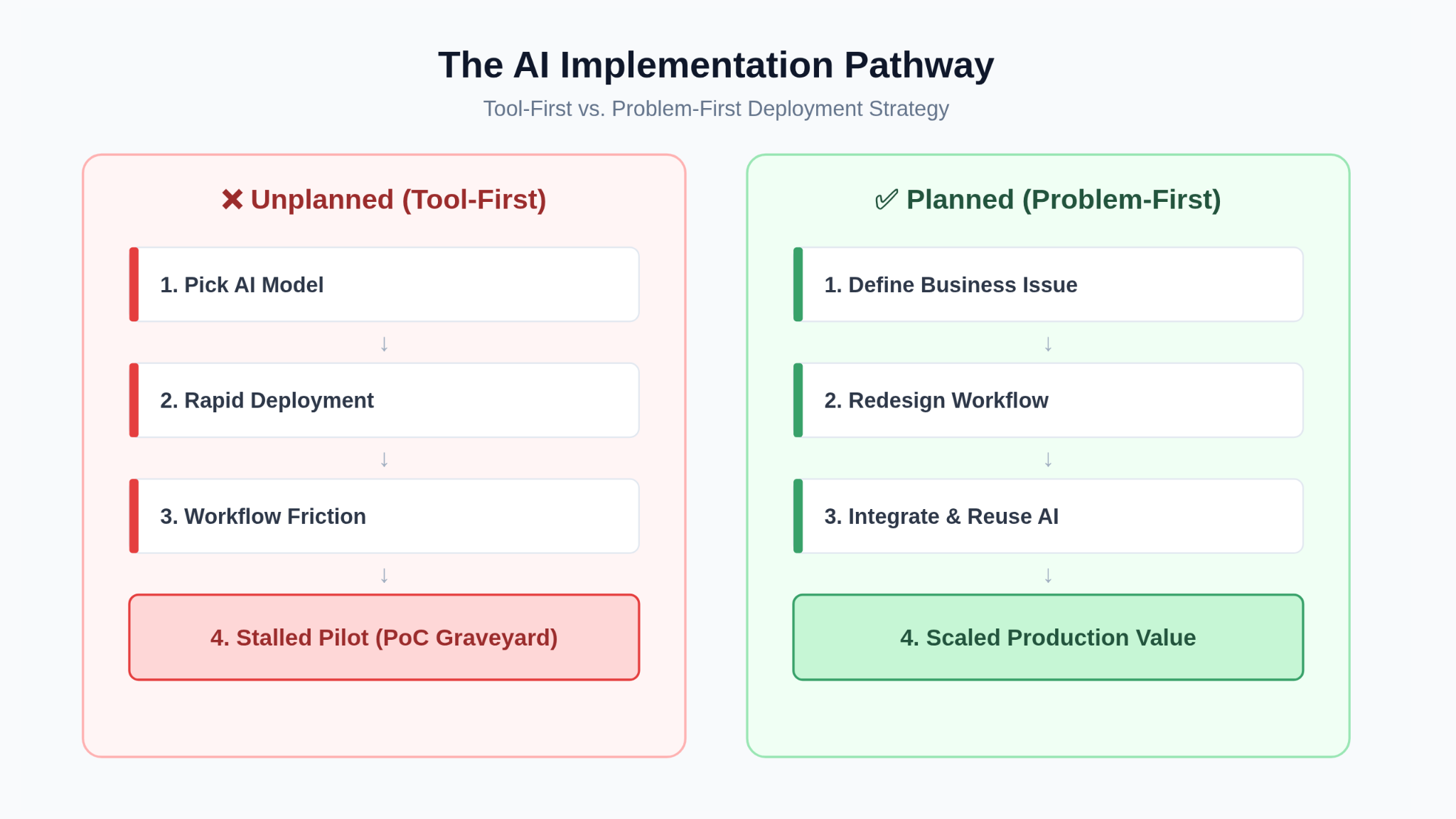
Most enterprise AI initiatives follow a familiar pattern: a team picks an exciting concept, launches a quick trial, and deploys a new tool. Soon after, progress halts. The system does not fit daily routines, employees return to established methods, and the project fails to expand.
This friction rarely stems from bad technology - it comes from implementing without prior planning. The real advantage is not simply having access to better AI. It is understanding what you want to achieve before deciding how AI should be used. According to McKinsey's Global AI Survey, 88% of organizations deploy AI in at least one function, yet only 6% achieve substantial financial returns. Broad studies from RAND Corporation on AI project failure highlight a major root cause: misaligned business objectives between leaders and technical teams, which prevents clear scope definition and accountability.
While experimentation is widespread across industries, most organizations remain stuck in this trial phase. Thorough planning before using AI is what bridges this gap, enabling teams to move beyond basic pilots into production-ready value.
To join the top 6% of high performers, organizations must adopt three core planning habits.
Habit 1: How do top teams define the problem before picking a tool?
Selecting software before identifying the primary business challenge leads to wasted capital and effort. Teams frequently select an AI model first, then search for internal applications. High-performing organizations reverse this sequence through structured evaluation:
- Identify the specific operational issue and establish baseline performance metrics.
- Outline the end-to-end process and analyze the user's current daily workflow.
- Define clear measurable targets for 30, 60, and 90-day benchmarks.
- Verify data availability, system permissions, and governance requirements.
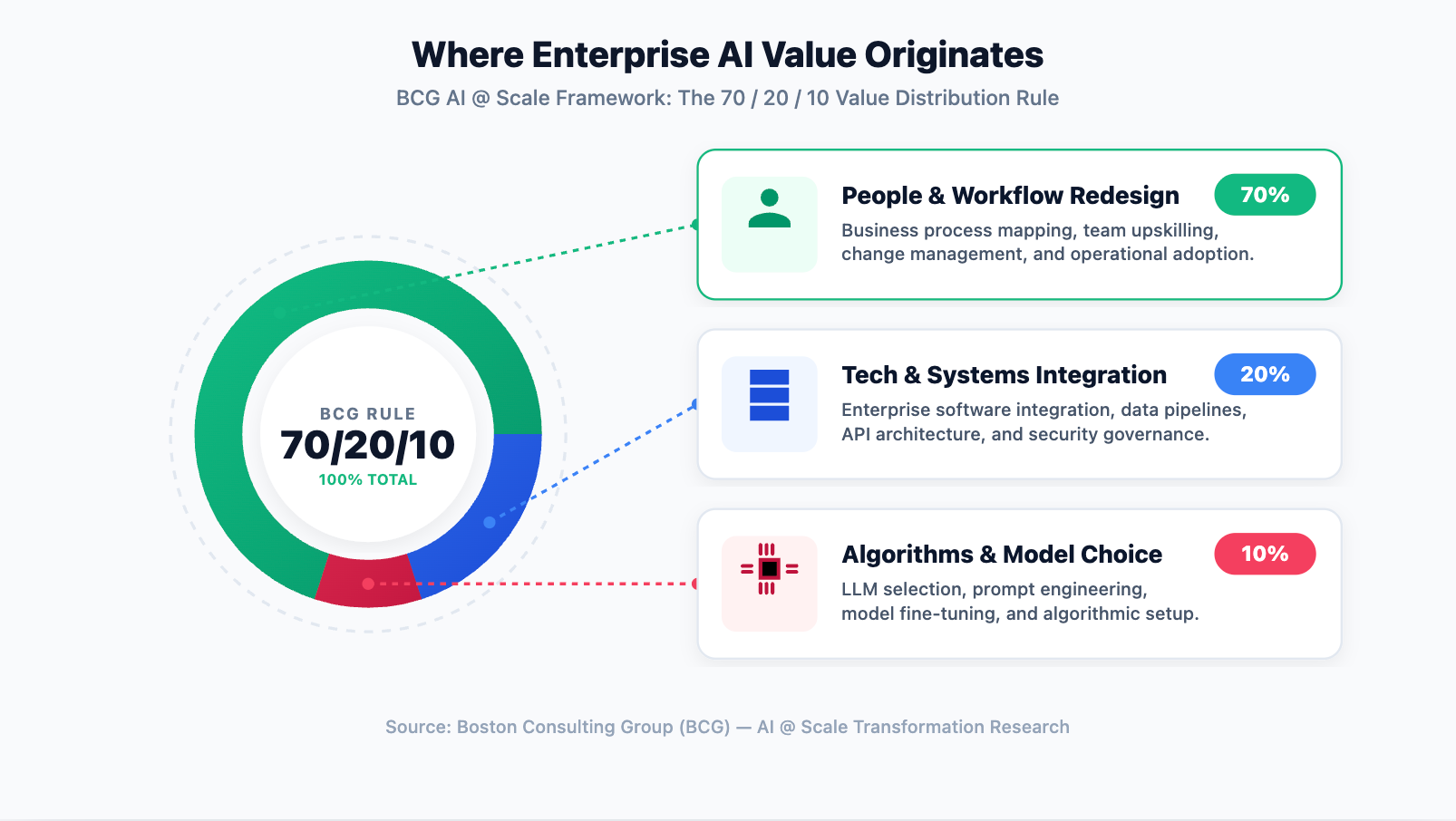
BCG’s 70-20-10 framework suggests that AI transformation depends far more on people and processes than algorithms alone: 10% relates to algorithms, 20% to technology and data, and 70% to people and process transformation.
Habit 2: Why should teams research and break down steps before building?
Instead of building right away, break the business process into smaller, manageable tasks:
- Map the Process: Chart every step, handoff point, and common bottleneck.
- Target AI Use: Identify the specific tasks where AI actually adds measurable value.
- Prep the Data: Gather the information, context, and guidelines the AI system requires.
- Connect the Steps: Plan how AI outputs flow back to team members for review and approval.
- Test Incrementally: Validate and refine one stage at a time prior to organization-wide rollout.
Research by Harvard Business School researchers emphasizes that scaling generative AI requires organizational maturity and workflow redesign rather than basic tool access. Likewise, data from McKinsey's research on AI rewiring confirms that leading organizations are nearly three times as likely to redesign step-by-step workflows before attempting to scale technology across departments.
Habit 3: How can organizations reuse existing tools instead of reinventing the wheel?
Avoid reinventing the wheel on every project - doing so wastes time and resources when proven solutions already exist. A benchmark study by BCG on AI value creation reveals that undergoing AI transformation has reshaped initiatives underway, often beginning with support functions before expanding into core business areas. This makes existing workflows, templates, and tools a useful starting point, rather than requiring a rebuild from scratch.
Before starting a custom engineering effort, evaluate three critical areas:
- Has an internal department already developed a functional framework for this issue?
- Does an established software provider or open-source tool resolve 80% of the core requirement?
- Can the team adapt existing prompt libraries and process structures rather than building from zero?
Only 10% of total financial returns stem from the underlying algorithm, while 90% comes from system integration and staff execution. Adapting existing tools allows organizations to capture that value far more rapidly.
What does planned AI implementation look like in practice?
Consider how two distinct approaches impact a customer service chatbot initiative:
- Unplanned Setup: The team quickly deploys a chatbot without defining operational scope. System answers prove inconsistent, handoffs fail, and the project gets canceled.
- Planned Setup: The team maps frequent inquiries, creates standardized response templates, and establishes clear rules for human escalation. The chatbot handles routine inquiries accurately from day one, freeing staff to address complex issues.
What is the real secret to scaling enterprise AI successfully?
Long-term success with AI depends on process discipline rather than model size. Sustainable growth requires clear problem definition, intentional workflow design, and strategic reuse of existing assets.
By anchoring AI initiatives in practical planning, organizations can move past endless experimentation and secure measurable operational value.
If your team is working through an AI implementation and wondering why results are not scaling, we would be glad to think it through with you. Tokyo Techies works with enterprises across Japan and internationally to design AI workflows that are built to produce real value - not just pilots.